Close Menu
Ztoog
    What's Hot
    Mobile

    Here are the best offers for a new Pixel 8, Bose’s latest QuietComfort buds or a refurbished iPhone

    Crypto

    Economist Predicts $115K Bitcoin Peak, Then Historic Crash

    The Future

    Ford delays $12B in EV investments as automaker wrestles with demand

    Important Pages:
    • About Us
    • Contact us
    • Privacy Policy
    • Terms & Conditions
    Facebook X (Twitter) Instagram Pinterest
    Facebook X (Twitter) Instagram Pinterest
    Ztoog
    • Home
    • The Future

      Livestream FA Cup Soccer: Watch Newcastle vs. Man City From Anywhere

      What is Project Management? 5 Best Tools that You Can Try

      Operational excellence strategy and continuous improvement

      Hannah Fry: AI isn’t as powerful as we think

      FanDuel goes all in on responsible gaming push with new Play with a Plan campaign

    • Technology

      Laser 3D Printing Could Build Lunar Base Structures

      Iran war: How could it end?

      Democratic senators question CFTC staffing cuts in Chicago enforcement office

      Google’s Cloud AI lead on the three frontiers of model capability

      AMD agrees to backstop a $300M loan from Goldman Sachs for Crusoe to buy AMD AI chips, the first known case of AMD chips used as debt collateral (The Information)

    • Gadgets

      How to Run Ethernet Cables to Your Router and Keep Them Tidy

      macOS Tahoe 26.3.1 update will “upgrade” your M5’s CPU to new “super” cores

      Lenovo Shows Off a ThinkBook Modular AI PC Concept With Swappable Ports and Detachable Displays at MWC 2026

      POCO M8 Review: The Ultimate Budget Smartphone With Some Cons

      The Mission: Impossible of SSDs has arrived with a fingerprint lock

    • Mobile

      Need a power station? These two Anker ones are nearly half off

      Android’s March update is all about finding people, apps, and your missing bags

      Watch Xiaomi’s global launch event live here

      Our poll shows what buyers actually care about in new smartphones (Hint: it’s not AI)

      Is Strava down for you? You’re not alone

    • Science

      Florida can’t decide if its official saltwater mammal is a dolphin or a porpoise

      Big Tech Signs White House Data Center Pledge With Good Optics and Little Substance

      Inside the best dark matter detector ever built

      NASA’s Artemis moon exploration programme is getting a major makeover

      Scientists crack the case of “screeching” Scotch tape

    • AI

      A “ChatGPT for spreadsheets” helps solve difficult engineering challenges faster | Ztoog

      Online harassment is entering its AI era

      Meet NullClaw: The 678 KB Zig AI Agent Framework Running on 1 MB RAM and Booting in Two Milliseconds

      New method could increase LLM training efficiency | Ztoog

      The human work behind humanoid robots is being hidden

    • Crypto

      Pundit Reveals Why Bitcoin Is Headed For Another Crash To $42,000

      Ethereum co-founder Jeffrey Wilcke sends $157M in ETH to Kraken after months of wallet silence

      SEC Vs. Justin Sun Case Ends In $10M Settlement

      Google paid startup Form Energy $1B for its massive 100-hour battery

      Ethereum Breakout Alert: Corrective Channel Flip Sparks Impulsive Wave

    Ztoog
    Home » How archaeologists reconstructed the burning of Jerusalem in 586 BCE
    Science

    How archaeologists reconstructed the burning of Jerusalem in 586 BCE

    Facebook Twitter Pinterest WhatsApp
    How archaeologists reconstructed the burning of Jerusalem in 586 BCE
    Share
    Facebook Twitter LinkedIn Pinterest WhatsApp

    Assaf Peretz/Israel Antiquities Authority

    There’s hardly ever time to put in writing about each cool science-y story that comes our approach. So this yr, we’re as soon as once more operating a particular Twelve Days of Christmas collection of posts, highlighting one science story that fell by way of the cracks in 2020, every day from December 25 by way of January 5. Today: Archaeologists relied on chemical clues and methods like FTIR spectroscopy and archaeomagnetic evaluation to reconstruct the burning of Jerusalem by Babylonian forces round 586 BCE.

    Archaeologists have uncovered new proof in help of Biblical accounts of the siege and burning of the metropolis of Jerusalem by the Babylonians round 586 BCE, in response to a September paper printed in the Journal of Archaeological Science.

    The Hebrew bible comprises the solely account of this momentous occasion, which included the destruction of Solomon’s Temple. “The Babylonian chronicles from these years were not preserved,” co-author Nitsan Shalom of Tel Aviv University in Israel informed New Scientist. According to the biblical account, “There was a violent and complete destruction, the whole city was burned and it stayed completely empty, like the descriptions you see in [the Book of] Lamentations about the city deserted and in complete misery.”

    Judah was a vassal kingdom of Babylon throughout the late seventh century BCE, underneath the rule of Nebuchadnezzar II. This didn’t sit properly with Judah’s king, Jehoiakim, who revolted towards the Babylonian king in 601 BCE regardless of being warned not to take action by the prophet Jeremiah. He stopped paying the required tribute and sided with Egypt when Nebuchadnezzar tried (and failed) to in invade that nation.  Jehoiakim died and his son Jeconiah succeeded him when Nebuchadnezzar’s forces besieged Jerusalem in 597 BCE. The metropolis was pillaged and Jeconiah surrendered and was deported to Babylon for his hassle, together with a considerable portion of Judah’s inhabitants. (The Book of Kings places the quantity at 10,000.) His uncle Zedekiah turned king of Judah.

    Zedekiah additionally chafed underneath Babylonian rule and revolted in flip, refusing to pay the required tribute and looking for alliance with the Egyptian pharaoh Hophra. This resulted in a brutal 30-month siege by Nebuchadnezzar’s forces towards Judah and its capital, Jerusalem. Eventually the Babylonians prevailed once more, breaking by way of the metropolis partitions to overcome Jerusalem. Zedekiah was pressured to look at his sons killed and was then blinded, sure, and brought to Babylon as a prisoner. This time Nebuchadnezzar was much less merciful and ordered his troops to utterly destroy Jerusalem and pull down the wall round 586 BCE.

    Advertisement

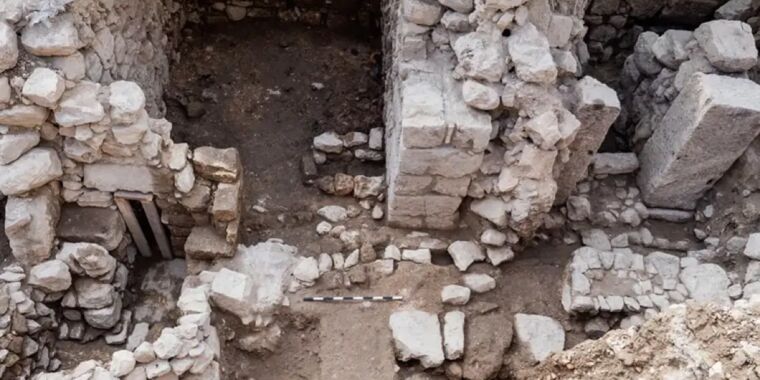
    There is archaeological proof to help the account of the metropolis being destroyed by hearth, together with close by villages and cities on the western border. Three residential constructions have been excavated between 1978 and 1982 and located to comprise burned picket beams relationship to round 586 BCE. Archaeologists additionally discovered ash and burned picket beams from the similar time interval after they excavated a number of constructions at the Giv’ati Parking Lot archaeological web site, near the assumed location of Solomon’s Temple. Samples taken from a plaster ground confirmed publicity to excessive temperatures of a minimum of 600 levels Celsius

    Aerial view of the excavation site in Jerusalem, at the foot of the Temple Mount
    Enlarge / Aerial view of the excavation web site in Jerusalem, at the foot of the Temple Mount

    Assaf Peretz/Israel Antiquities Authority

    However, it wasn’t doable to find out from that proof whether or not the fires have been intentional or unintentional, or the place the hearth began if it was certainly intentional. For this newest analysis, Shalom and her colleagues targeted on the two-story Building 100 at the Giv’ati Parking Lot web site. They used Fourier remodel infrared (FTIR) spectroscopy—which measures the absorption of infrared mild to find out to what diploma a pattern had been heated—and archaeomagnetic evaluation, which determines whether or not samples containing magnetic minerals have been sufficiently heated to reorient these compounds to a brand new magnetic north.

    The evaluation revealed various levels of publicity to high-temperature hearth in three rooms (designated A, B, and C) on the backside stage of Building 100, with Room C displaying the most blatant proof. This may need been an indication that Room C was the ignition level, however there was no hearth path; the burning of Room C seemed to be remoted. Combined with an earlier 2020 examine on segments of the second stage of the constructing, the authors concluded that a number of fires have been lit in the constructing and the fires burned strongest in the higher flooring, apart from that “intense native hearth” in Room C on the first stage.

    Advertisement

    “When a construction burns, warmth rises and is concentrated under the ceiling,” the authors wrote. “The partitions and roof are due to this fact heated to larger temperatures than the ground.” The presence of charred beams on the flooring recommend this was certainly the case: most of the warmth rose to the ceiling, burning the beams till they collapsed to the flooring, which in any other case have been subjected to radiant warmth. But the extent of the particles was probably not induced simply by that collapse, suggesting that the Babylonians intentionally went again in and knocked down any remaining partitions.

    Furthermore, “They focused the extra necessary, the extra well-known buildings in the metropolis,” Shalom informed New Scientist, quite than destroying every little thing indiscriminately. “2600 years later, we’re nonetheless mourning the temple.”

    While they discovered no proof of further fuels which may have served as accelerants, “we might assume the hearth was deliberately ignited  attributable to its widespread presence in all rooms and each tales of the constructing,” Shalom et al. concluded. “The finds inside the rooms point out there was sufficient flammable materials (vegetal and picket gadgets and building materials) to make further gasoline pointless. The widespread presence of charred stays suggests a deliberate destruction by hearth…. [T]he unfold of the hearth and the speedy collapse of the constructing point out that the destroyers invested nice efforts to utterly demolish the constructing and take it out of use.”

    DOI: Journal of Archaeological Science, 2023. 10.1016/j.jas.2023.105823  (About DOIs).

    Share. Facebook Twitter Pinterest LinkedIn WhatsApp

    Related Posts

    Science

    Florida can’t decide if its official saltwater mammal is a dolphin or a porpoise

    Science

    Big Tech Signs White House Data Center Pledge With Good Optics and Little Substance

    Science

    Inside the best dark matter detector ever built

    Science

    NASA’s Artemis moon exploration programme is getting a major makeover

    Science

    Scientists crack the case of “screeching” Scotch tape

    Science

    Blue-faced, puffy-lipped monkey scores a rare conservation win

    Science

    Big Tech Says Generative AI Will Save the Planet. It Doesn’t Offer Much Proof

    Science

    The experiments that could finally explain gravity

    Leave A Reply Cancel Reply

    Follow Us
    • Facebook
    • Twitter
    • Pinterest
    • Instagram
    Top Posts
    Gadgets

    7 Best TV Deals to Catch Up on Oscar-Nominated Films (or the Super Bowl)

    It’s virtually Super Bowl Sunday, which implies pleasant soccer gatherings, gagillion-dollar commercials, and, naturally, huge…

    Mobile

    Android defectors reveal the main reason for switching to iOS

    For the mast majority – 53 p.c to be precise – of the Android defectors,…

    Mobile

    Honor returns to India with a familiar figure at the helm

    What you want to knowHonor is all set to make its re-entry into the Indian…

    AI

    Meet VLM-CaR (Code as Reward): A New Machine Learning Framework Empowering Reinforcement Learning with Vision-Language Models

    Researchers from Google DeepMind have collaborated with Mila, and McGill University outlined acceptable reward capabilities…

    Mobile

    Top 10 trending phones of week 22

    Week 22 introduced few adjustments to our trending chart, the Samsung Galaxy A54 taking its…

    Our Picks
    Mobile

    OnePlus 13: Rumors, specs, and everything we want to see

    Technology

    Sources: the US Dept. of Commerce plans to propose barring Chinese software in autonomous vehicles and some Chinese wireless communications hardware in US cars (David Shepardson/Reuters)

    Crypto

    Bitcoin Blast? Trump’s Fury Over High Rates Signals Big Move

    Categories
    • AI (1,561)
    • Crypto (1,829)
    • Gadgets (1,871)
    • Mobile (1,911)
    • Science (1,940)
    • Technology (1,863)
    • The Future (1,717)
    Most Popular
    Mobile

    vivo X Fold3 and X Fold3 Pro rumored to be unveiled at the end of March

    AI

    Nobody knows how AI works

    AI

    New open-source tool helps to detangle the brain | Ztoog

    Ztoog
    Facebook X (Twitter) Instagram Pinterest
    • Home
    • About Us
    • Contact us
    • Privacy Policy
    • Terms & Conditions
    © 2026 Ztoog.

    Type above and press Enter to search. Press Esc to cancel.