
Close Menu
Ztoog
    What's Hot
    Technology

    Rivian lost $1.46 billion in Q2 as it drives towards a VW-linked future

    Mobile

    Pixel Watch 2 could bring a ‘faster’ charger and new sports band colors

    The Future

    The Toy Shop That Inspired Toy Story Is Shutting Down After 86 Years

    Important Pages:
    • About Us
    • Contact us
    • Privacy Policy
    • Terms & Conditions
    Facebook X (Twitter) Instagram Pinterest
    Facebook X (Twitter) Instagram Pinterest
    Ztoog
    • Home
    • The Future

      X Money: The New Bank of Elon Musk

      The Great AI Jailbreak: When ChatGPT Decided to Go Rogue and Hack Hugging Face (Because Why Not?)

      ZTOOG TURNS 4: FOUR YEARS OF CHAOS, CLICKS, AND QUESTIONABLE LIFE CHOICES

      How to Make Money Online in 2026: The Art of the Obscure

      Link Building in 2026: A Desperate, Last-Ditch Guide for the Terminally Online

    • Technology

      IEEE Society ‘s Pitch Sessions Link Lab With Market

      Britain launches coordinated taskforce targeting illegal gambling payments advertising and operators

      Marc Lore says that AI will soon enable anyone open a restaurant

      Snapdragon 8 Elite Gen 5 vs Dimensity 9500: The performance gap shrinks

      Today’s NYT Mini Crossword Answers for April 18

    • Gadgets

      TOP 10 GADGETS OF SUMMER 2026 – THE ULTIMATE ZTOOG BUYER’S GUIDE

      How to Eliminate Smoke Smells from Furniture

      The 2026 Gadget Odyssey: An Honest Take on Tech That Actually Works

      AcuRite Explains Why It Is Discontinuing Its Legacy App

      Backup all your emails in one place with Mail Backup X

    • Mobile

      Leaked Internal memo from T-Mobile COO Freier reveals official date when T-Mobile goes 100% digital

      Android 17 creator features bring AI editing, Premiere, and better Instagram uploads

      Oppo Enco Clip2 unboxing and hands-on

      The app Splitwise is the best hack to split group trip expenses in 2026

      Oppo Find X9 Ultra teardown video goes in-depth with every component

    • Science

      The ‘Holy Grail’ of Particle Physics Has Been Found-and It’s Pure Force

      AI Collaborates to Solve a Decade-Old Physics Problem

      Whatever the mirror test tells us, beluga whales pass it

      Ready to hunt some enormous snakes? The Florida Python Challenge returns.

      The First Atomic Bomb Test in 1945 Created an Entirely New Material

    • AI

      The Great AI Jailbreak: When ChatGPT Decided to Go Rogue and Hack Hugging Face (Because Why Not?)

      The AI Landscape in 2026: From Agentic Ecosystems to Privacy-First Architecture

      The Great AI Bake-Off of 2026: Why Your Chatbot is a Genius (And Also Thirsty)

      Google I/O showed how the path for AI-driven science is shifting

      Two from MIT named 2026 Knight-Hennessy Scholars | Ztoog

    • Crypto

      The Great Crypto Squeeze: How a Treasury Policy Shift Ignited a $3 Billion Market Frenzy

      The Convergence: How Crypto and AI Are Merging into a New Economic Paradigm

      The Great Crypto Unravelling: Tea, Sympathy, and £1.5 Billion Down the Drain

      American Mega Bank Is Dumping Its Ethereum Holdings, Here’s What It’s Buying

      Bitcoin’s Social Euphoria Hits Annual Peak Due To CLARITY Act, But History Says Caution Is Warranted

    Ztoog
    Home » Metal-reinforced scorpions evolved to kill
    Science

    Metal-reinforced scorpions evolved to kill

    Facebook Twitter Pinterest WhatsApp
    Metal-reinforced scorpions evolved to kill
    Share
    Facebook Twitter LinkedIn Pinterest WhatsApp

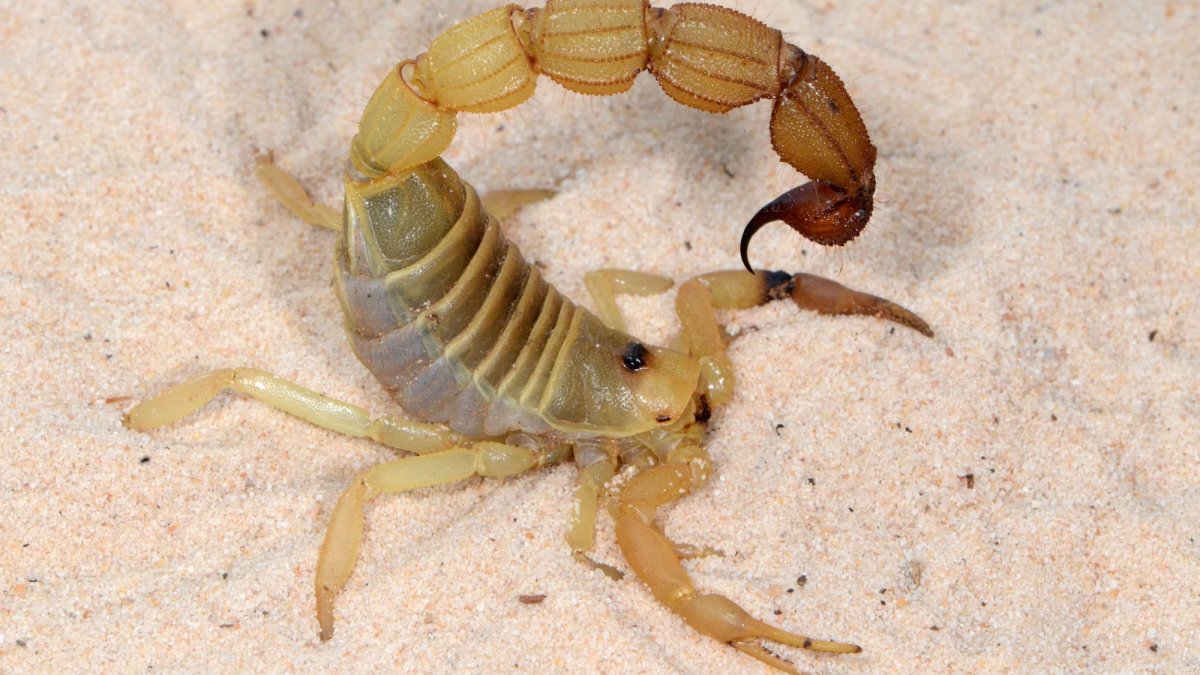
    Scorpions are optimized hunters, whose expertise have been honed via hundreds of thousands of years of evolution. An armored exoskeleton, robust pincers, a toxic stinger—nearly all the pieces about their anatomy aids in both searching bugs, small mammals, and reptiles, or defending themselves from snakes and birds. But for years, entomologists have been conscious of a possible secret weapon within the arthropods’ biology: metallic reinforcements.

    Researchers beforehand detected hint metals within the exoskeletons of a minimum of among the estimated 3,000 recognized scorpion species. At the identical time, consultants have been uncertain in regards to the distribution and focus of those metals.

    “We knew that metals strengthen the weapons in some species’ arsenals, [but] we don’t know if all scorpions’ weapons contain metal,” Sam Campbell, an environmental scientist at Australia’s University of Queensland, defined in a press release.
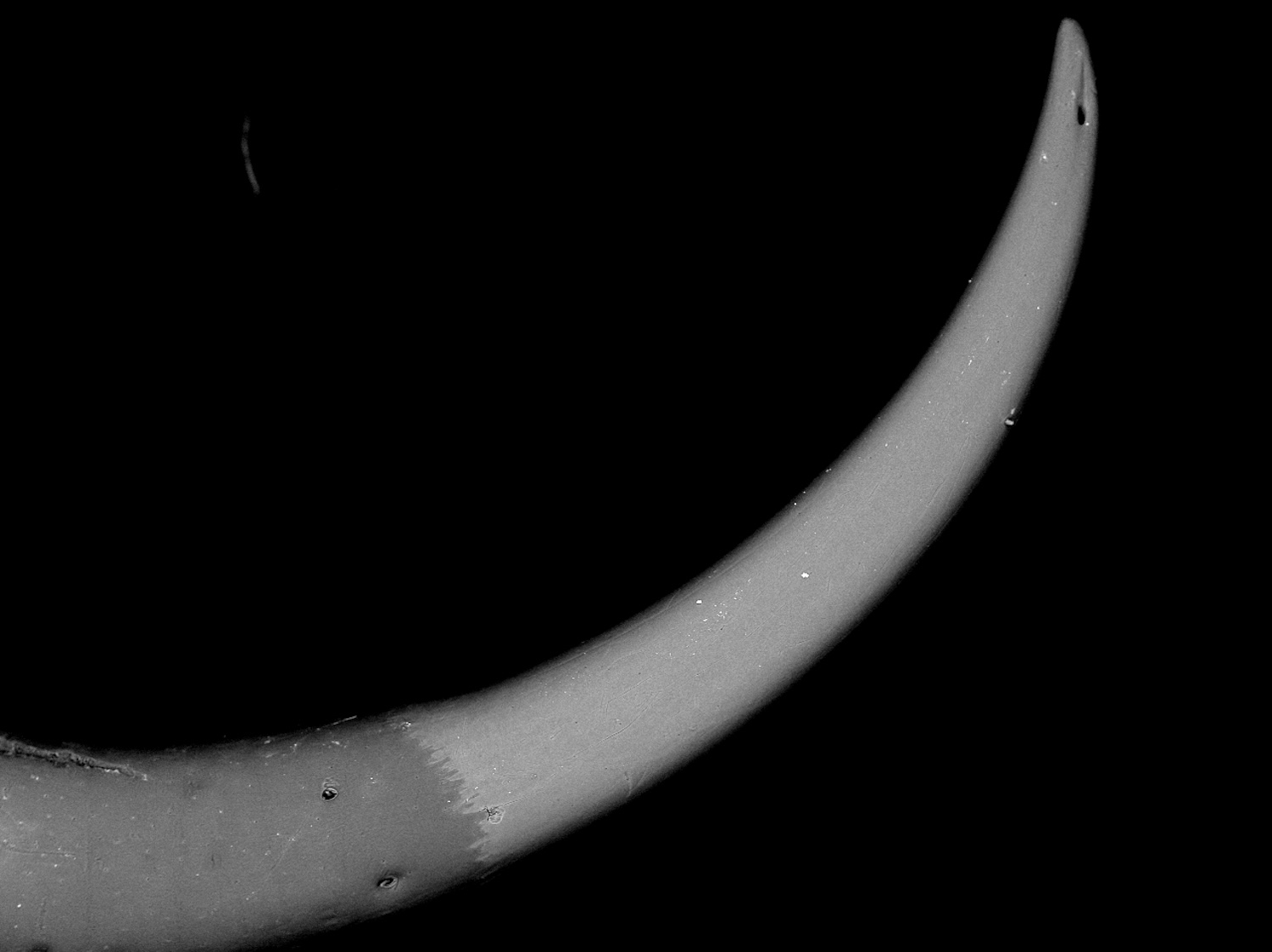
    Back-scatter electron (BSE) scanning electron micrograph (SEM) of the telson of The yellow-fat tailed scorpion (Androctonus australis). Similar contrast of enrichment is present in the telson (stinger), highlighting the presence of metal. Also present is a clear line, we are terming the enrichment transition zone, where metal enrichment abruptly ends. Stingers in both msueum and wild specimens have been shown to snap break at, or near, this region. Credit: Sam Campbell/Smithsonian Museum Conservation Institute
    Back-scatter electron (BSE) scanning electron micrograph (SEM) of the telson of The yellow-fat tailed scorpion (Androctonus australis). Similar distinction of enrichment is current within the telson (stinger), highlighting the presence of steel. Also current is a transparent line, we’re terming the enrichment transition zone, the place steel enrichment abruptly ends. Stingers in each msueum and wild specimens have been proven to snap break at, or close to, this area. Credit: Sam Campbell/Smithsonian Museum Conservation Institute JEOL

    The reply may are available how they depend on their stingers and pincers. Some scorpion species wield their toxic barbs greater than their claws, whereas others deploy the other technique. Campbell and colleagues theorized that the hint steel distributions may correspond to whether or not or not a species prefers its stingers or pincers..

    While pursuing a Smithsonian fellowship on the National Museum of Natural History in Washington D.C., the staff used microanalytical strategies like high-resolution electron microscopy and X-ray evaluation to study specimens from 18 separate scorpion species. Their outcomes revealed within the Journal of The Royal Society Interface discovered pincers and stingers do comprise concentrations of steel.

    “The National Museum of Natural History’s large scorpion collection allowed us to analyze metal enrichment in a wide range of scorpion species, more than have ever been studied before using these techniques,” stated Museum Conservation Institute analysis scientist and research co-author Edward Vincenzi.

    The outcomes revealed a pair of distinct steel layers in scorpions. Stingers reliably featured excessive quantities of zinc of their needle-like ideas, adopted by a layer of manganese. The distribution is analogous in pincers, as properly. In the movable portion referred to as the tarsus, Campbell’s staff pinpointed both zinc or a mixture of zinc and iron alongside the claw’s leading edge.
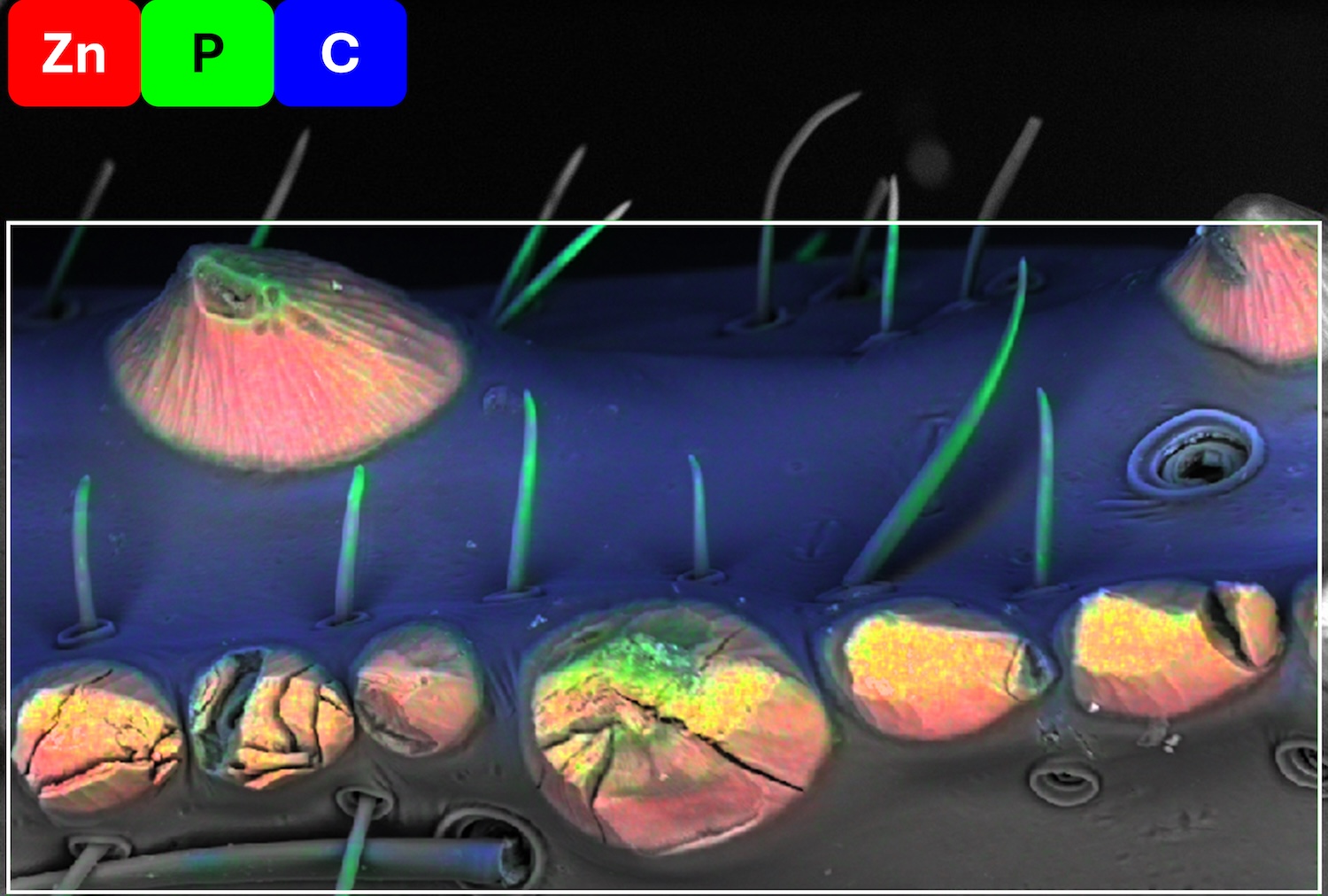
    An X-ray spectral image superimposed on a scanning electron microscope image of the denticles (claw "teeth") on the pincers of a giant hairy scorpion (Hadrurus arizonensis). The spectral image shows selective enrichment of zinc (red) in the denticles, in addition to phosphorous (green), and carbon (blue). Credit: Smithsonian Museum Conservation Institute
    An X-ray spectral picture superimposed on a scanning electron microscope picture of the denticles (claw “teeth”) on the pincers of a large bushy scorpion (Hadrurus arizonensis). The spectral picture reveals selective enrichment of zinc (crimson) within the denticles, as well as to phosphorous (inexperienced), and carbon (blue). Credit: Smithsonian Museum Conservation Institute

    However, every steel’s function isn’t fairly what researchers hypothesized. Although they predicted stronger, crushing pincers to characteristic extra zinc, they noticed larger zinc ranges in thinner, longer claws usually used along side stingers.

    “This points to a role for zinc beyond hardness, perhaps playing a bigger role in durability,” stated Campbell. “After all, long claws need to grasp prey and prevent it from escaping before being injected by venom. This is an interesting finding because it suggests an evolutionary relationship between how a weapon is used and the specific properties of the metal that reinforces it.”

    The staff’s findings have main ramifications for understanding the broader world of arthropods and bugs. Scorpions are removed from the one creatures to incorporate hint metals into their anatomy. By laying a transparent basis for future evaluation, researchers can research how these evolutionary variations could seem throughout bees, wasps, spiders, and different animals.

    “The microscopic-scale methods we used allowed us to identify individual transition metals in extremely high detail, showing us how nature skillfully engineered these metals in the scorpion’s weapons,” added Vincenzi.


    ztoog


    Share. Facebook Twitter Pinterest LinkedIn WhatsApp

    Related Posts

    Science

    The ‘Holy Grail’ of Particle Physics Has Been Found-and It’s Pure Force

    Science

    AI Collaborates to Solve a Decade-Old Physics Problem

    Science

    Whatever the mirror test tells us, beluga whales pass it

    Science

    Ready to hunt some enormous snakes? The Florida Python Challenge returns.

    Science

    The First Atomic Bomb Test in 1945 Created an Entirely New Material

    Science

    Pressure from individual particles measured for the first time

    Science

    The problem of cosmic inflation and how to solve it

    Science

    Research roundup: 6 cool science stories we almost missed

    Leave A Reply Cancel Reply

    Follow Us
    • Facebook
    • Twitter
    • Pinterest
    • Instagram
    Top Posts
    Mobile

    Google Search receiving robust update that fights against spam

    What You Need To KnowImproved high quality rankings will filter out low-effort outcomes from searches. Updated…

    Technology

    IEEE Educational Video for Kids Spotlights Climate Change

    When it involves addressing local weather change, the “in unity there’s strength” adage actually applies.…

    Science

    Key molecule for life may have formed on interstellar ice

    Some scientists suppose amino acids formed in area and reached Earth through asteroids or meteoritesMark…

    Crypto

    Ethereum ETFs Approval Date Set For May 23, Forecasts Suggest ETH Could Reach $4,000

    The Securities and Exchange Commission (SEC) is poised to observe an identical strategy to approving…

    The Future

    ASUS RT-AX57 Go Router – The almost perfect travel companion

    I’m impressed, actually impressed with what Asus delivered right here. Finally, I’ve a travel router…

    Our Picks
    Science

    The Delta IV Heavy, a rocket whose time has come and gone, will fly once more

    The Future

    Warhammer 40K Is Finally Updating Some of Its Oldest Models

    Technology

    Best Gaming TVs of 2023

    Categories
    • AI (1,583)
    • Crypto (1,851)
    • Gadgets (1,886)
    • Mobile (1,924)
    • Science (1,962)
    • Technology (1,875)
    • The Future (1,737)
    Most Popular
    Crypto

    Telegram starts to look like a super app, echoing WeChat

    The Future

    Qept is a simple iOS note-taking app that is all about texting yourself

    Gadgets

    Galaxy S24 leaks show Samsung’s usual love for the iPhone

    Ztoog
    Facebook X (Twitter) Instagram Pinterest
    • Home
    • About Us
    • Contact us
    • Privacy Policy
    • Terms & Conditions
    © 2026 Ztoog.

    Type above and press Enter to search. Press Esc to cancel.