
Close Menu
Ztoog
    What's Hot
    Crypto

    USDC stablecoin issuer Circle files confidentially for an IPO

    Science

    The moon is 40 million years older than we thought it was

    AI

    Novo Nordisk to support MIT postdocs working at the intersection of AI and life sciences | Ztoog

    Important Pages:
    • About Us
    • Contact us
    • Privacy Policy
    • Terms & Conditions
    Facebook X (Twitter) Instagram Pinterest
    Facebook X (Twitter) Instagram Pinterest
    Ztoog
    • Home
    • The Future

      What is Project Management? 5 Best Tools that You Can Try

      Operational excellence strategy and continuous improvement

      Hannah Fry: AI isn’t as powerful as we think

      FanDuel goes all in on responsible gaming push with new Play with a Plan campaign

      Gettyimages.com Is the Best Website on the Internet Right Now

    • Technology

      Iran war: How could it end?

      Democratic senators question CFTC staffing cuts in Chicago enforcement office

      Google’s Cloud AI lead on the three frontiers of model capability

      AMD agrees to backstop a $300M loan from Goldman Sachs for Crusoe to buy AMD AI chips, the first known case of AMD chips used as debt collateral (The Information)

      Productivity apps failed me when I needed them most

    • Gadgets

      macOS Tahoe 26.3.1 update will “upgrade” your M5’s CPU to new “super” cores

      Lenovo Shows Off a ThinkBook Modular AI PC Concept With Swappable Ports and Detachable Displays at MWC 2026

      POCO M8 Review: The Ultimate Budget Smartphone With Some Cons

      The Mission: Impossible of SSDs has arrived with a fingerprint lock

      6 Best Phones With Headphone Jacks (2026), Tested and Reviewed

    • Mobile

      Android’s March update is all about finding people, apps, and your missing bags

      Watch Xiaomi’s global launch event live here

      Our poll shows what buyers actually care about in new smartphones (Hint: it’s not AI)

      Is Strava down for you? You’re not alone

      The Motorola Razr FIFA World Cup 2026 Edition was literally just unveiled, and Verizon is already giving them away

    • Science

      Big Tech Signs White House Data Center Pledge With Good Optics and Little Substance

      Inside the best dark matter detector ever built

      NASA’s Artemis moon exploration programme is getting a major makeover

      Scientists crack the case of “screeching” Scotch tape

      Blue-faced, puffy-lipped monkey scores a rare conservation win

    • AI

      Online harassment is entering its AI era

      Meet NullClaw: The 678 KB Zig AI Agent Framework Running on 1 MB RAM and Booting in Two Milliseconds

      New method could increase LLM training efficiency | Ztoog

      The human work behind humanoid robots is being hidden

      NVIDIA Releases DreamDojo: An Open-Source Robot World Model Trained on 44,711 Hours of Real-World Human Video Data

    • Crypto

      Google paid startup Form Energy $1B for its massive 100-hour battery

      Ethereum Breakout Alert: Corrective Channel Flip Sparks Impulsive Wave

      Show Your ID Or No Deal

      Jane Street sued for alleged front-running trades that accelerated Terraform Labs meltdown

      Bitcoin Trades Below ETF Cost-Basis As MVRV Signals Mounting Pressure

    Ztoog
    Home » Scientists 3D print a robotic hand with human-like bones and tendons 
    Science

    Scientists 3D print a robotic hand with human-like bones and tendons 

    Facebook Twitter Pinterest WhatsApp
    Scientists 3D print a robotic hand with human-like bones and tendons 
    Share
    Facebook Twitter LinkedIn Pinterest WhatsApp

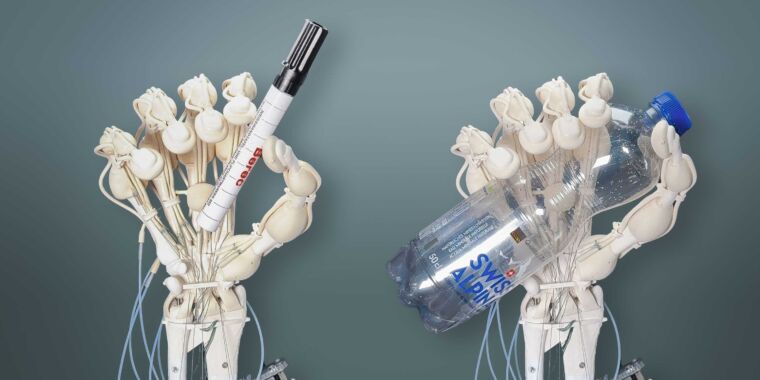
    Enlarge / The 3D-printed hand made by way of the brand new technique.

    Have you ever questioned why robots are unable to stroll and transfer their our bodies as fluidly as we do? Some robots can run, bounce, or dance with larger effectivity than people, however their physique actions additionally appear mechanical. The motive for this lies within the bones they lack.

    Unlike people and animals, robots shouldn’t have actual bones or the versatile tissues that join them; they’ve synthetic hyperlinks and joints fabricated from supplies like carbon fiber and metallic tubes. According to Robert Katzschmann, a professor of robotics at ETH Zurich, these inside constructions enable a robotic to make actions, seize objects, and preserve totally different postures. However, since hyperlinks and joints are made up of exhausting supplies, robotic our bodies are usually not as versatile, agile, and comfortable as human our bodies. This is what makes their physique actions so stiff.

    But they could not want to remain stiff for lengthy. A staff of researchers from the Swiss Federal Institute of Technology (ETH) Zurich and US-based startup Inkbit have discovered a approach to 3D print the world’s first robotic hand with an inside construction composed of human-like bones, ligaments, and tendons. What makes the hand much more particular is that it was printed utilizing a wholly new 3D inkjet deposition technique known as vision-controlled jetting (VCJ).

    3D printing vs. robots

    Currently, robots which are 3D printed are sometimes made utilizing fast-curing polyacrylates. These polymers are sturdy and solidify quickly throughout deposition. However, to keep away from any irregularities, “Each printed layer requires mechanical planarization [the process of smoothing an uneven surface by using mechanical force], which limits the levels of softness and the type of material chemistries that can be used,” the researchers be aware. This is why normal 3D-printed robots are usually not very elastic and are restricted of their shapes and supplies.

    Advertisement

    Due to the speedy solidification of the printed materials, scientists don’t have the time to make modifications in several layers, and they need to make use of separate manufacturing steps and meeting to make the totally different elements of a single robotic. Once they’re completed printing every half, they assemble these totally different items and completely take a look at them, making the method time-consuming and tedious.

    This is the place the proposed VCJ technique could make a enormous distinction. This 3D printing course of concerned using comfortable, slow-curing thiolene polymers. “These have very good elastic properties and return to their original state much faster after bending than polyacrylates,” stated Katzschmann, one of many authors on a new paper that describes the brand new technique.

    Rethinking 3D printing for robots

    In a VCJ system, alongside with a 3D printer, there’s a 3D laser scanner that visually inspects every layer for floor irregularities because it’s deposited. “This visual inspection makes the print process fully contactless, allowing for a wider range of possible polymers to be deposited. We, for example, printed with thiol-based polymers because it enabled us to create UV-light and humidity-resistant structures,” Katzschmann instructed Ars Technica.

    After the scanning, there isn’t any mechanical planarization of the deposited layer. Instead, the following layer is printed in such a method that it makes up for all of the irregularities within the earlier layer. “A feedback mechanism compensates for these irregularities when printing the next layer by calculating any necessary adjustments to the amount of material to be printed in real-time and with pinpoint accuracy,” stated Wojciech Matusik, one of many examine authors and a professor of laptop science at MIT.

    Moreover, the researchers declare that this closed-loop managed system permits them to print the entire construction of a robotic directly. “Our robotic hand can be printed in one go, no assembly is needed. This speeds up the engineering design process immensely—one can go directly from an idea to a functional and lasting prototype. You avoid expensive intermediate tooling and assembly,” Katzschmann added.

    Advertisement

    Using the VCJ approach, the researchers efficiently printed a robotic hand that has inside constructions much like these of a human hand. Equipped with contact pads and stress sensors, the robotic hand has 19 tendon-like constructions (in people, tendons are the fibrous connective tissues that join bones and muscle tissue) that enable it to maneuver the wrist and fingers. The hand can sense contact, seize issues, and cease fingers after they contact one thing. (The researchers used MRI information from a actual human hand to mannequin its development.)

    VCJ’s future

    In addition to the hand, additionally they printed a robotic coronary heart, a six-legged robotic, and a metamaterial able to absorbing vibrations in its environment. The researchers counsel that every one these robots work like hybrid soft-rigid techniques (robots which are fabricated from each comfortable and exhausting supplies) that may outperform exhausting robots when it comes to flexibility and overcome the design- and scale-related points confronted by comfortable robots.

    Since comfortable robots are fabricated from versatile supplies like fluids or elastomers, it’s difficult for scientists to take care of their geometry and energy at bigger scales, because the supplies might wrestle to retain their bodily properties and structural integrity. Plus, it’s a lot simpler to manage and energy a centimeter or millimeter-scale comfortable robotic; because of this they’re made smaller. VCJ, on the opposite hand, has the potential to provide rise to scalable hybrid soft-rigid robots.

    “We foresee that VCJ will eventually replace all contact-based inkjet printing methods. With VCJ you can start producing functional parts for robotics, medical implants, and various other industries. The high resolution, suitable material properties, and their long lifetime make prints from the VCJ system very useful for both research and commercial applications,” Katzschmann instructed Ars Technica.

    Nature, 2023. DOI: 10.1038/s41586-023-06684-3  (About DOIs)

    Rupendra Brahambhatt is an skilled journalist and filmmaker. He covers science and tradition information, and for the final 5 years, he has been actively working with a few of the most modern information businesses, magazines, and media manufacturers working in several components of the globe.

    Share. Facebook Twitter Pinterest LinkedIn WhatsApp

    Related Posts

    Science

    Big Tech Signs White House Data Center Pledge With Good Optics and Little Substance

    Science

    Inside the best dark matter detector ever built

    Science

    NASA’s Artemis moon exploration programme is getting a major makeover

    Science

    Scientists crack the case of “screeching” Scotch tape

    Science

    Blue-faced, puffy-lipped monkey scores a rare conservation win

    Science

    Big Tech Says Generative AI Will Save the Planet. It Doesn’t Offer Much Proof

    Science

    The experiments that could finally explain gravity

    Science

    Weird inside-out planet system may have formed one world at a time

    Leave A Reply Cancel Reply

    Follow Us
    • Facebook
    • Twitter
    • Pinterest
    • Instagram
    Top Posts
    Science

    Polaris Dawn mission is one giant leap for private space exploration

    An artist’s rendering of the spacewalk on the Polaris Dawn missionSpaceX SpaceX’s Polaris Dawn mission…

    Crypto

    Bitcoin Open Interest Remains High Despite Price Drop, What’s The Significance?

    In an fascinating flip of occasions, the Bitcoin open curiosity has remained excessive even at…

    AI

    MIT researchers combine deep learning and physics to fix motion-corrupted MRI scans | Ztoog

    Compared to different imaging modalities like X-rays or CT scans, MRI scans present high-quality delicate…

    Science

    Mars may have captured and split a comet to create its two moons

    Mars has two irregularly formed moons, an internal moon named Phobos and an outer moon…

    Science

    We may finally know what causes will-o’-the-wisps

    An 1849 engraving depicting a will-o’-the-wispSSPL/Getty Images Bubbles merging in water can spontaneously generate electrical…

    Our Picks
    Mobile

    Google Messages update officially removes nav drawer

    Science

    The stargazing events to look forward to in 2025

    Gadgets

    Redis’ license change and forking are a mess that everybody can feel bad about

    Categories
    • AI (1,560)
    • Crypto (1,826)
    • Gadgets (1,870)
    • Mobile (1,910)
    • Science (1,939)
    • Technology (1,862)
    • The Future (1,716)
    Most Popular
    Technology

    9 questions about Kevin McCarthy’s downfall and what’s next for the House GOP chaos, answered

    The Future

    Microsoft Introduces Copilot Pro at $20 Per User For One Month

    The Future

    10 Stretching Apps Fitness Pros Swear By to Get in Some Quick Mobility Work

    Ztoog
    Facebook X (Twitter) Instagram Pinterest
    • Home
    • About Us
    • Contact us
    • Privacy Policy
    • Terms & Conditions
    © 2026 Ztoog.

    Type above and press Enter to search. Press Esc to cancel.