Close Menu
Ztoog
    What's Hot
    AI

    This AI Paper Proposes a Novel Pre-Training Strategy Called Privacy-Preserving MAE-Align’ to Effectively Combine Synthetic Data and Human-Removed Real Data

    Gadgets

    16 Best Camera Accessories for Phones (2023): Apps, Tripods, Mics, and Lights

    Gadgets

    High-Precision Robotics: Tessolo’s DG-3F Gripper’s For Manufacturing

    Important Pages:
    • About Us
    • Contact us
    • Privacy Policy
    • Terms & Conditions
    Facebook X (Twitter) Instagram Pinterest
    Facebook X (Twitter) Instagram Pinterest
    Ztoog
    • Home
    • The Future

      What is Project Management? 5 Best Tools that You Can Try

      Operational excellence strategy and continuous improvement

      Hannah Fry: AI isn’t as powerful as we think

      FanDuel goes all in on responsible gaming push with new Play with a Plan campaign

      Gettyimages.com Is the Best Website on the Internet Right Now

    • Technology

      Iran war: How could it end?

      Democratic senators question CFTC staffing cuts in Chicago enforcement office

      Google’s Cloud AI lead on the three frontiers of model capability

      AMD agrees to backstop a $300M loan from Goldman Sachs for Crusoe to buy AMD AI chips, the first known case of AMD chips used as debt collateral (The Information)

      Productivity apps failed me when I needed them most

    • Gadgets

      macOS Tahoe 26.3.1 update will “upgrade” your M5’s CPU to new “super” cores

      Lenovo Shows Off a ThinkBook Modular AI PC Concept With Swappable Ports and Detachable Displays at MWC 2026

      POCO M8 Review: The Ultimate Budget Smartphone With Some Cons

      The Mission: Impossible of SSDs has arrived with a fingerprint lock

      6 Best Phones With Headphone Jacks (2026), Tested and Reviewed

    • Mobile

      Android’s March update is all about finding people, apps, and your missing bags

      Watch Xiaomi’s global launch event live here

      Our poll shows what buyers actually care about in new smartphones (Hint: it’s not AI)

      Is Strava down for you? You’re not alone

      The Motorola Razr FIFA World Cup 2026 Edition was literally just unveiled, and Verizon is already giving them away

    • Science

      Big Tech Signs White House Data Center Pledge With Good Optics and Little Substance

      Inside the best dark matter detector ever built

      NASA’s Artemis moon exploration programme is getting a major makeover

      Scientists crack the case of “screeching” Scotch tape

      Blue-faced, puffy-lipped monkey scores a rare conservation win

    • AI

      Online harassment is entering its AI era

      Meet NullClaw: The 678 KB Zig AI Agent Framework Running on 1 MB RAM and Booting in Two Milliseconds

      New method could increase LLM training efficiency | Ztoog

      The human work behind humanoid robots is being hidden

      NVIDIA Releases DreamDojo: An Open-Source Robot World Model Trained on 44,711 Hours of Real-World Human Video Data

    • Crypto

      Google paid startup Form Energy $1B for its massive 100-hour battery

      Ethereum Breakout Alert: Corrective Channel Flip Sparks Impulsive Wave

      Show Your ID Or No Deal

      Jane Street sued for alleged front-running trades that accelerated Terraform Labs meltdown

      Bitcoin Trades Below ETF Cost-Basis As MVRV Signals Mounting Pressure

    Ztoog
    Home » The brain power behind sustainable AI | Ztoog
    AI

    The brain power behind sustainable AI | Ztoog

    Facebook Twitter Pinterest WhatsApp
    The brain power behind sustainable AI | Ztoog
    Share
    Facebook Twitter LinkedIn Pinterest WhatsApp

    How can you employ science to construct a greater gingerbread home?

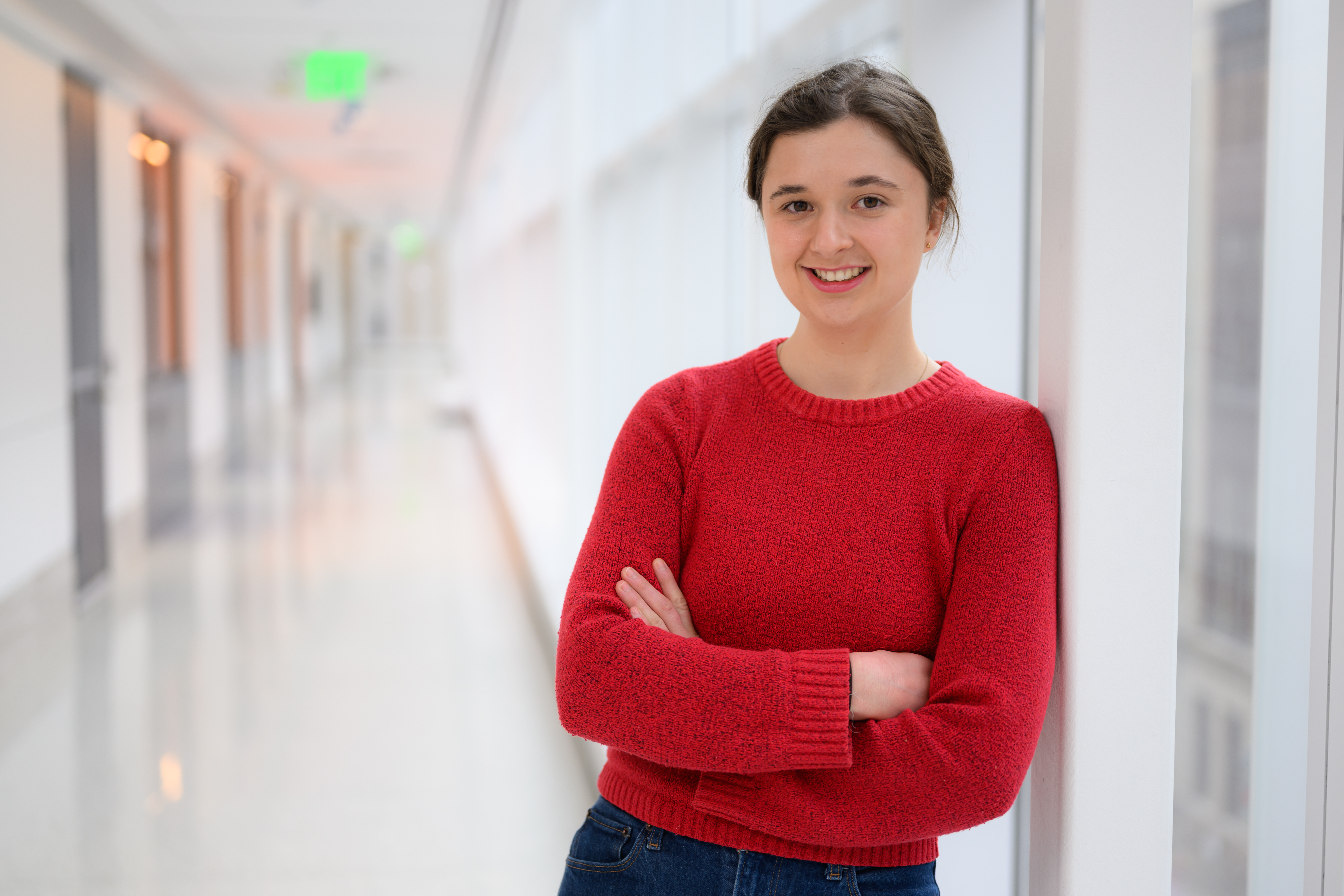
    That was one thing Miranda Schwacke spent loads of time fascinated by. The MIT graduate scholar within the Department of Materials Science and Engineering (DMSE) is a part of Kitchen Matters, a gaggle of grad college students who use meals and kitchen instruments to clarify scientific ideas by brief movies and outreach occasions. Past matters included why chocolate “seizes,” or turns into tough to work with when melting (spoiler: water will get in), and the right way to make isomalt, the sugar glass that stunt performers bounce by in motion films.

    Two years in the past, when the group was making a video on the right way to construct a structurally sound gingerbread home, Schwacke scoured cookbooks for a variable that will produce probably the most dramatic distinction within the cookies.

    “I was reading about what determines the texture of cookies, and then tried several recipes in my kitchen until I got two gingerbread recipes that I was happy with,” Schwacke says.

    She centered on butter, which accommodates water that turns to steam at excessive baking temperatures, creating air pockets in cookies. Schwacke predicted that reducing the quantity of butter would yield denser gingerbread, robust sufficient to carry collectively as a home.

    “This hypothesis is an example of how changing the structure can influence the properties and performance of material,” Schwacke stated within the eight-minute video.

    That similar curiosity about supplies properties and efficiency drives her analysis on the excessive vitality value of computing, particularly for synthetic intelligence. Schwacke develops new supplies and gadgets for neuromorphic computing, which mimics the brain by processing and storing data in the identical place. She research electrochemical ionic synapses — tiny gadgets that may be “tuned” to regulate conductivity, very like neurons strengthening or weakening connections within the brain.

    “If you look at AI in particular — to train these really large models — that consumes a lot of energy. And if you compare that to the amount of energy that we consume as humans when we’re learning things, the brain consumes a lot less energy,” Schwacke says. “That’s what led to this idea to find more brain-inspired, energy-efficient ways of doing AI.”

    Her advisor, Bilge Yildiz, underscores the purpose: One purpose the brain is so environment friendly is that information doesn’t must be moved backwards and forwards.

    “In the brain, the connections between our neurons, called synapses, are where we process information. Signal transmission is there. It is processed, programmed, and also stored in the same place,” says Yildiz, the Breene M. Kerr (1951) Professor within the Department of Nuclear Science and Engineering and DMSE. Schwacke’s gadgets goal to duplicate that effectivity.

    Scientific roots

    The daughter of a marine biologist mother and {an electrical} engineer dad, Schwacke was immersed in science from a younger age. Science was “always a part of how I understood the world.”

    “I was obsessed with dinosaurs. I wanted to be a paleontologist when I grew up,” she says. But her pursuits broadened. At her center college in Charleston, South Carolina, she joined a FIRST Lego League robotics competitors, constructing robots to finish duties like pushing or pulling objects. “My parents, my dad especially, got very involved in the school team and helping us design and build our little robot for the competition.”

    Her mom, in the meantime, studied how dolphin populations are affected by air pollution for the National Oceanic and Atmospheric Administration. That had a long-lasting impression.

    “That was an example of how science can be used to understand the world, and also to figure out how we can improve the world,” Schwacke says. “And that’s what I’ve always wanted to do with science.”

    Her curiosity in supplies science got here later, in her highschool magnet program. There, she was launched to the interdisciplinary topic, a mix of physics, chemistry, and engineering that research the construction and properties of supplies and makes use of that data to design new ones.

    “I always liked that it goes from this very basic science, where we’re studying how atoms are ordering, all the way up to these solid materials that we interact with in our everyday lives — and how that gives them their properties that we can see and play with,” Schwacke says.

    As a senior, she participated in a analysis program with a thesis venture on dye-sensitized photo voltaic cells, a low-cost, light-weight photo voltaic expertise that makes use of dye molecules to soak up gentle and generate electrical energy.

    “What drove me was really understanding, this is how we go from light to energy that we can use — and also seeing how this could help us with having more renewable energy sources,” Schwacke says.

    After highschool, she headed throughout the nation to Caltech. “I wanted to try a totally new place,” she says, the place she studied supplies science, together with nanostructured supplies 1000’s of occasions thinner than a human hair. She centered on supplies properties and microstructure — the tiny inside construction that governs how supplies behave — which led her to electrochemical techniques like batteries and gas cells.

    AI vitality problem

    At MIT, she continued exploring vitality applied sciences. She met Yildiz throughout a Zoom assembly in her first 12 months of graduate college, in fall 2020, when the campus was nonetheless working underneath strict Covid-19 protocols. Yildiz’s lab research how charged atoms, or ions, transfer by supplies in applied sciences like gas cells, batteries, and electrolyzers.

    The lab’s analysis into brain-inspired computing fired Schwacke’s creativeness, however she was equally drawn to Yildiz’s means of speaking about science.

    “It wasn’t based on jargon and emphasized a very basic understanding of what was going on — that ions are going here, and electrons are going here — to understand fundamentally what’s happening in the system,” Schwacke says.

    That mindset formed her method to analysis. Her early tasks centered on the properties these gadgets must work effectively — quick operation, low vitality use, and compatibility with semiconductor expertise — and on utilizing magnesium ions as a substitute of hydrogen, which might escape into the setting and make gadgets unstable.

    Her present venture, the main target of her PhD thesis, facilities on understanding how the insertion of magnesium ions into tungsten oxide, a steel oxide whose electrical properties will be exactly tuned, adjustments its electrical resistance. In these gadgets, tungsten oxide serves as a channel layer, the place resistance controls sign energy, very like synapses regulate alerts within the brain.

    “I am trying to understand exactly how these devices change the channel conductance,” Schwacke says.

    Schwacke’s analysis was acknowledged with a MathWorks Fellowship from the School of Engineering in 2023 and 2024. The fellowship helps graduate college students who leverage instruments like MATLAB or Simulink of their work; Schwacke utilized MATLAB for essential information evaluation and visualization.

    Yildiz describes Schwacke’s analysis as a novel step towards fixing one in every of AI’s greatest challenges.

    “This is electrochemistry for brain-inspired computing,” Yildiz says. “It’s a new context for electrochemistry, but also with an energy implication, because the energy consumption of computing is unsustainably increasing. We have to find new ways of doing computing with much lower energy, and this is one way that can help us move in that direction.”

    Like any pioneering work, it comes with challenges, particularly in bridging the ideas between electrochemistry and semiconductor physics.

    “Our group comes from a solid-state chemistry background, and when we started this work looking into magnesium, no one had used magnesium in these kinds of devices before,” Schwacke says. “So we were looking at the magnesium battery literature for inspiration and different materials and strategies we could use. When I started this, I wasn’t just learning the language and norms for one field — I was trying to learn it for two fields, and also translate between the two.”

    She additionally grapples with a problem acquainted to all scientists: the right way to make sense of messy information.

    “The main challenge is being able to take my data and know that I’m interpreting it in a way that’s correct, and that I understand what it actually means,” Schwacke says.

    She overcomes hurdles by collaborating carefully with colleagues throughout fields, together with neuroscience and electrical engineering, and typically by simply making small adjustments to her experiments and watching what occurs subsequent.

    Community issues

    Schwacke isn’t just lively within the lab. In Kitchen Matters, she and her fellow DMSE grad college students arrange cubicles at native occasions just like the Cambridge Science Fair and Steam It Up, an after-school program with hands-on actions for teenagers.

    “We did ‘pHun with Food’ with ‘fun’ spelled with a pH, so we had cabbage juice as a pH indicator,” Schwacke says. “We let the kids test the pH of lemon juice and vinegar and dish soap, and they had a lot of fun mixing the different liquids and seeing all the different colors.”

    She has additionally served because the social chair and treasurer for DMSE’s graduate scholar group, the Graduate Materials Council. As an undergraduate at Caltech, she led workshops in science and expertise for Robogals, a student-run group that encourages younger girls to pursue careers in science, and assisted college students in making use of for the varsity’s Summer Undergraduate Research Fellowships.

    For Schwacke, these experiences sharpened her capability to clarify science to totally different audiences, a talent she sees as very important whether or not she’s presenting at a youngsters’ honest or at a analysis convention.

    “I always think, where is my audience starting from, and what do I need to explain before I can get into what I’m doing so that it’ll all make sense to them?” she says.

    Schwacke sees the flexibility to speak as central to constructing neighborhood, which she considers an vital a part of doing analysis. “It helps with spreading ideas. It always helps to get a new perspective on what you’re working on,” she says. “I also think it keeps us sane during our PhD.”

    Yildiz sees Schwacke’s neighborhood involvement as an vital a part of her resume. “She’s doing all these activities to motivate the broader community to do research, to be interested in science, to pursue science and technology, but that ability will help her also progress in her own research and academic endeavors.”

    After her PhD, Schwacke desires to take that capability to speak along with her to academia, the place she’d prefer to encourage the subsequent era of scientists and engineers. Yildiz has little doubt she’ll thrive.

    “I think she’s a perfect fit,” Yildiz says. “She’s brilliant, but brilliance by itself is not enough. She’s persistent, resilient. You really need those on top of that.”

    Share. Facebook Twitter Pinterest LinkedIn WhatsApp

    Related Posts

    AI

    Online harassment is entering its AI era

    AI

    Meet NullClaw: The 678 KB Zig AI Agent Framework Running on 1 MB RAM and Booting in Two Milliseconds

    AI

    New method could increase LLM training efficiency | Ztoog

    AI

    The human work behind humanoid robots is being hidden

    AI

    NVIDIA Releases DreamDojo: An Open-Source Robot World Model Trained on 44,711 Hours of Real-World Human Video Data

    AI

    Personalization features can make LLMs more agreeable | Ztoog

    AI

    AI is already making online crimes easier. It could get much worse.

    AI

    NVIDIA Researchers Introduce KVTC Transform Coding Pipeline to Compress Key-Value Caches by 20x for Efficient LLM Serving

    Leave A Reply Cancel Reply

    Follow Us
    • Facebook
    • Twitter
    • Pinterest
    • Instagram
    Top Posts
    The Future

    EV sales remained strong in Q4. They could have been stronger

    All automakers, together with Tesla, are at a crossroads If you’ve solely been studying headlines…

    The Future

    Solana’s price rises to $160, highest level since January 2022 as memecoin mania rises

    Dogwifhat and politically-inspired tokens of President Biden and Trump additionally see price spikes Jacquelyn Melinek…

    Crypto

    Ethereum Faces Market Tremors As Celsius Offloads $1 Billion in ETH

    Ethereum (ETH) is about witnessing a possible sell-off value $1 billion. This vital transaction is…

    Mobile

    No camera upgrades is my biggest disapointment with the Galaxy S24 and S24 Plus

    Robert Triggs / Android AuthorityGalaxy S24 The new Samsung Galaxy S24 collection is a little…

    Mobile

    Best Buy is now selling Samsung’s mighty Galaxy S22 Ultra at colossal discounts with activation

    Released greater than a 12 months and a half in the past with then-state-of-the-art specs…

    Our Picks
    Crypto

    FTX Exploiter Executes Ongoing Funds Exodus, Moves $17 Million In ETH In One Day

    Science

    A scientific mission to save the sharks

    Mobile

    Gmail gets AI-powered “Summarize” feature on iOS and Android, Gemini side panel on the web

    Categories
    • AI (1,560)
    • Crypto (1,826)
    • Gadgets (1,870)
    • Mobile (1,910)
    • Science (1,939)
    • Technology (1,862)
    • The Future (1,716)
    Most Popular
    The Future

    We must move faster to understand and regulate AI, says Rishi Sunak

    Crypto

    Robinhood CEO Partly Blames Inflation for 23% Cut in Employees

    Crypto

    A New Player Just Joined The Game

    Ztoog
    Facebook X (Twitter) Instagram Pinterest
    • Home
    • About Us
    • Contact us
    • Privacy Policy
    • Terms & Conditions
    © 2026 Ztoog.

    Type above and press Enter to search. Press Esc to cancel.