
Close Menu
Ztoog
    What's Hot
    Science

    How we could discover quantum gravity without rebuilding space-time

    Technology

    From DoorDash to UberEats, why is food delivery so expensive?

    Science

    An alternative way to picture the standard model of particle physics

    Important Pages:
    • About Us
    • Contact us
    • Privacy Policy
    • Terms & Conditions
    Facebook X (Twitter) Instagram Pinterest
    Facebook X (Twitter) Instagram Pinterest
    Ztoog
    • Home
    • The Future

      X Money: The New Bank of Elon Musk

      The Great AI Jailbreak: When ChatGPT Decided to Go Rogue and Hack Hugging Face (Because Why Not?)

      ZTOOG TURNS 4: FOUR YEARS OF CHAOS, CLICKS, AND QUESTIONABLE LIFE CHOICES

      How to Make Money Online in 2026: The Art of the Obscure

      Link Building in 2026: A Desperate, Last-Ditch Guide for the Terminally Online

    • Technology

      IEEE Society ‘s Pitch Sessions Link Lab With Market

      Britain launches coordinated taskforce targeting illegal gambling payments advertising and operators

      Marc Lore says that AI will soon enable anyone open a restaurant

      Snapdragon 8 Elite Gen 5 vs Dimensity 9500: The performance gap shrinks

      Today’s NYT Mini Crossword Answers for April 18

    • Gadgets

      TOP 10 GADGETS OF SUMMER 2026 – THE ULTIMATE ZTOOG BUYER’S GUIDE

      How to Eliminate Smoke Smells from Furniture

      The 2026 Gadget Odyssey: An Honest Take on Tech That Actually Works

      AcuRite Explains Why It Is Discontinuing Its Legacy App

      Backup all your emails in one place with Mail Backup X

    • Mobile

      Leaked Internal memo from T-Mobile COO Freier reveals official date when T-Mobile goes 100% digital

      Android 17 creator features bring AI editing, Premiere, and better Instagram uploads

      Oppo Enco Clip2 unboxing and hands-on

      The app Splitwise is the best hack to split group trip expenses in 2026

      Oppo Find X9 Ultra teardown video goes in-depth with every component

    • Science

      The ‘Holy Grail’ of Particle Physics Has Been Found-and It’s Pure Force

      AI Collaborates to Solve a Decade-Old Physics Problem

      Whatever the mirror test tells us, beluga whales pass it

      Ready to hunt some enormous snakes? The Florida Python Challenge returns.

      The First Atomic Bomb Test in 1945 Created an Entirely New Material

    • AI

      The Great AI Jailbreak: When ChatGPT Decided to Go Rogue and Hack Hugging Face (Because Why Not?)

      The AI Landscape in 2026: From Agentic Ecosystems to Privacy-First Architecture

      The Great AI Bake-Off of 2026: Why Your Chatbot is a Genius (And Also Thirsty)

      Google I/O showed how the path for AI-driven science is shifting

      Two from MIT named 2026 Knight-Hennessy Scholars | Ztoog

    • Crypto

      The Convergence: How Crypto and AI Are Merging into a New Economic Paradigm

      The Great Crypto Unravelling: Tea, Sympathy, and £1.5 Billion Down the Drain

      American Mega Bank Is Dumping Its Ethereum Holdings, Here’s What It’s Buying

      Bitcoin’s Social Euphoria Hits Annual Peak Due To CLARITY Act, But History Says Caution Is Warranted

      Anthropic warns investors to avoid unauthorized secondary market sellers

    Ztoog
    Home » 5 AI Model Architectures Every AI Engineer Should Know
    AI

    5 AI Model Architectures Every AI Engineer Should Know

    Facebook Twitter Pinterest WhatsApp
    5 AI Model Architectures Every AI Engineer Should Know
    Share
    Facebook Twitter LinkedIn Pinterest WhatsApp

    Everyone talks about LLMs—however in the present day’s AI ecosystem is much greater than simply language fashions. Behind the scenes, a complete household of specialised architectures is quietly remodeling how machines see, plan, act, section, characterize ideas, and even run effectively on small gadgets. Each of those fashions solves a distinct a part of the intelligence puzzle, and collectively they’re shaping the following technology of AI programs.

    In this text, we’ll discover the 5 main gamers: Large Language Models (LLMs), Vision-Language Models (VLMs), Mixture of Experts (MoE), Large Action Models (LAMs) & Small Language Models (SLMs).

    Large Language Models (LLMs)

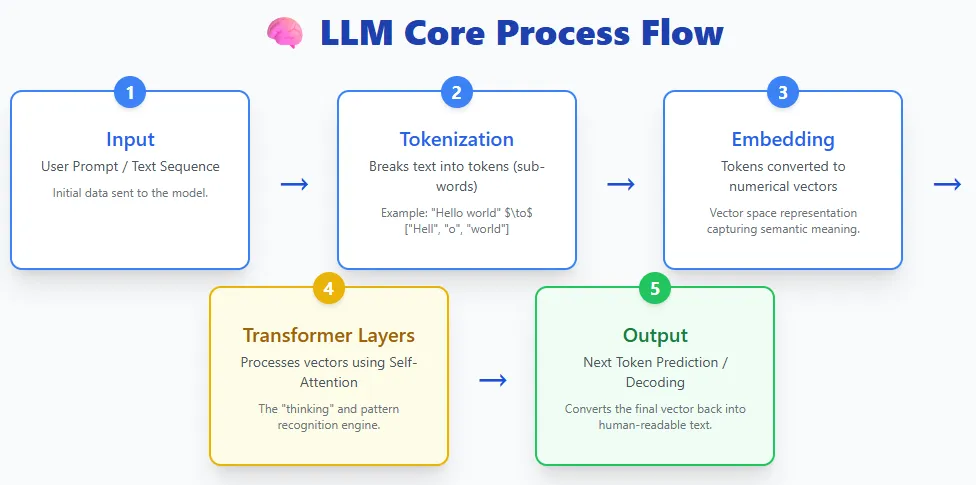
    LLMs soak up textual content, break it into tokens, flip these tokens into embeddings, go them via layers of transformers, and generate textual content again out. Models like ChatGPT, Claude, Gemini, Llama, and others all comply with this fundamental course of.

    At their core, LLMs are deep studying fashions educated on huge quantities of textual content knowledge. This coaching permits them to grasp language, generate responses, summarize data, write code, reply questions, and carry out a variety of duties. They use the transformer structure, which is extraordinarily good at dealing with lengthy sequences and capturing advanced patterns in language.

    Today, LLMs are extensively accessible via shopper instruments and assistants—from OpenAI’s ChatGPT and Anthropic’s Claude to Meta’s Llama fashions, Microsoft Copilot, and Google’s Gemini and BERT/PaLM household. They’ve grow to be the muse of recent AI functions due to their versatility and ease of use.
    5 AI Model Architectures Every AI Engineer Should Know

    Vision-Language Models (VLMs)

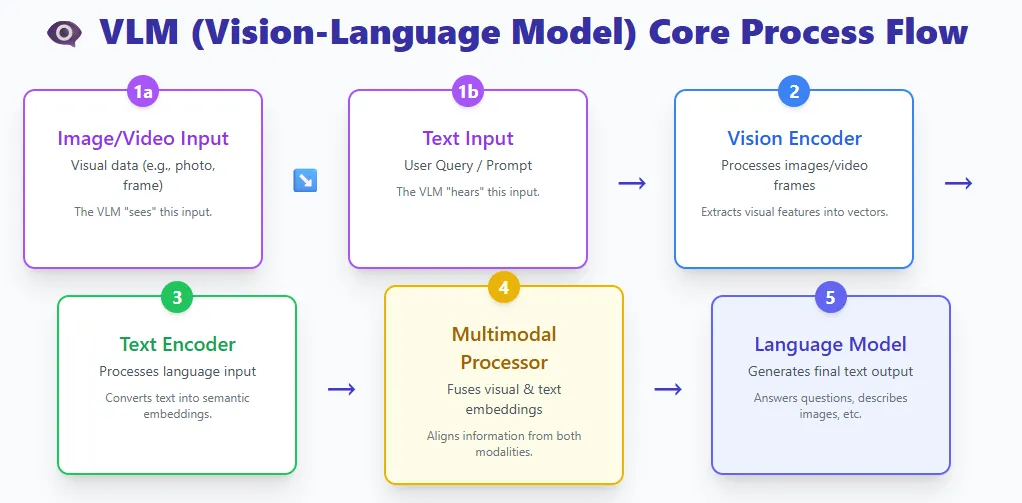
    VLMs mix two worlds:

    • A imaginative and prescient encoder that processes photographs or video
    • A textual content encoder that processes language

    Both streams meet in a multimodal processor, and a language mannequin generates the ultimate output.

    Examples embody GPT-4V, Gemini Pro Vision, and LLaVA.

    A VLM is actually a big language mannequin that has been given the flexibility to see. By fusing visible and textual content representations, these fashions can perceive photographs, interpret paperwork, reply questions on footage, describe movies, and extra.

    Traditional pc imaginative and prescient fashions are educated for one slender process—like classifying cats vs. canines or extracting textual content from a picture—they usually can’t generalize past their coaching courses. If you want a brand new class or process, you have to retrain them from scratch.

    VLMs take away this limitation. Trained on big datasets of photographs, movies, and textual content, they’ll carry out many imaginative and prescient duties zero-shot, just by following pure language directions. They can do all the things from picture captioning and OCR to visible reasoning and multi-step doc understanding—all with out task-specific retraining.

    This flexibility makes VLMs some of the highly effective advances in fashionable AI.
    Mixture of Experts (MoE)

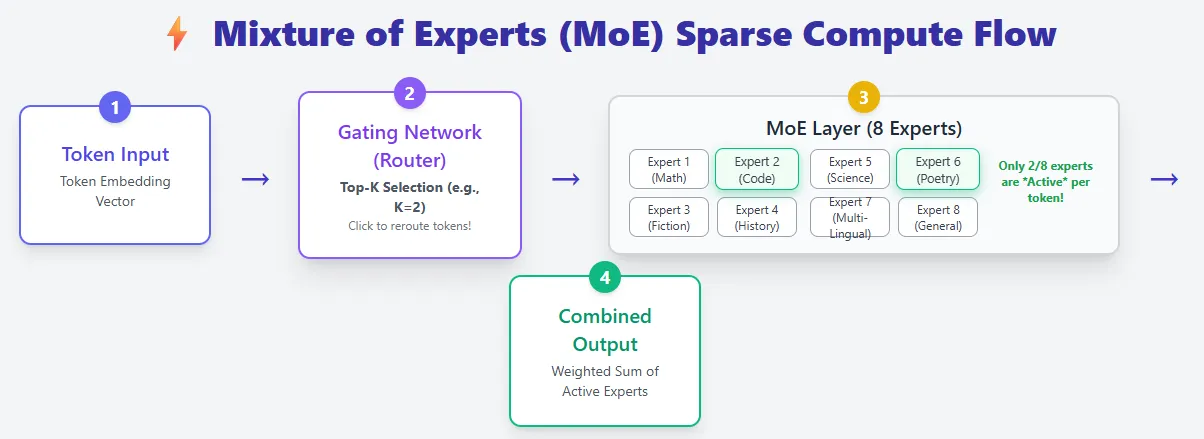
    Mixture of Experts fashions construct on the usual transformer structure however introduce a key improve: as an alternative of 1 feed-forward community per layer, they use many smaller skilled networks and activate only some for every token. This makes MoE fashions extraordinarily environment friendly whereas providing huge capability.

    In a daily transformer, each token flows via the identical feed-forward community, which means all parameters are used for each token. MoE layers exchange this with a pool of specialists, and a router decides which specialists ought to course of every token (Top-Ok choice). As a outcome, MoE fashions could have way more complete parameters, however they solely compute with a small fraction of them at a time—giving sparse compute.

    For instance, Mixtral 8×7B has 46B+ parameters, but every token makes use of solely about 13B.

    This design drastically reduces inference price. Instead of scaling by making the mannequin deeper or wider (which will increase FLOPs), MoE fashions scale by including extra specialists, boosting capability with out elevating per-token compute. This is why MoEs are sometimes described as having “bigger brains at lower runtime cost.”
    Large Action Models (LAMs)

    Large Action Models go a step past producing textual content—they flip intent into motion. Instead of simply answering questions, a LAM can perceive what a consumer needs, break the duty into steps, plan the required actions, after which execute them in the actual world or on a pc.

    A typical LAM pipeline contains:

    • Perception – Understanding the consumer’s enter
    • Intent recognition – Identifying what the consumer is attempting to realize
    • Task decomposition – Breaking the aim into actionable steps
    • Action planning + reminiscence – Choosing the best sequence of actions utilizing previous and current context
    • Execution – Carrying out duties autonomously

    Examples embody Rabbit R1, Microsoft’s UFO framework, and Claude Computer Use, all of which might function apps, navigate interfaces, or full duties on behalf of a consumer.

    LAMs are educated on huge datasets of actual consumer actions, giving them the flexibility to not simply reply, however act—reserving rooms, filling varieties, organizing recordsdata, or performing multi-step workflows. This shifts AI from a passive assistant into an energetic agent able to advanced, real-time decision-making.

    (*5*)

    Small Language Models (SLMs)

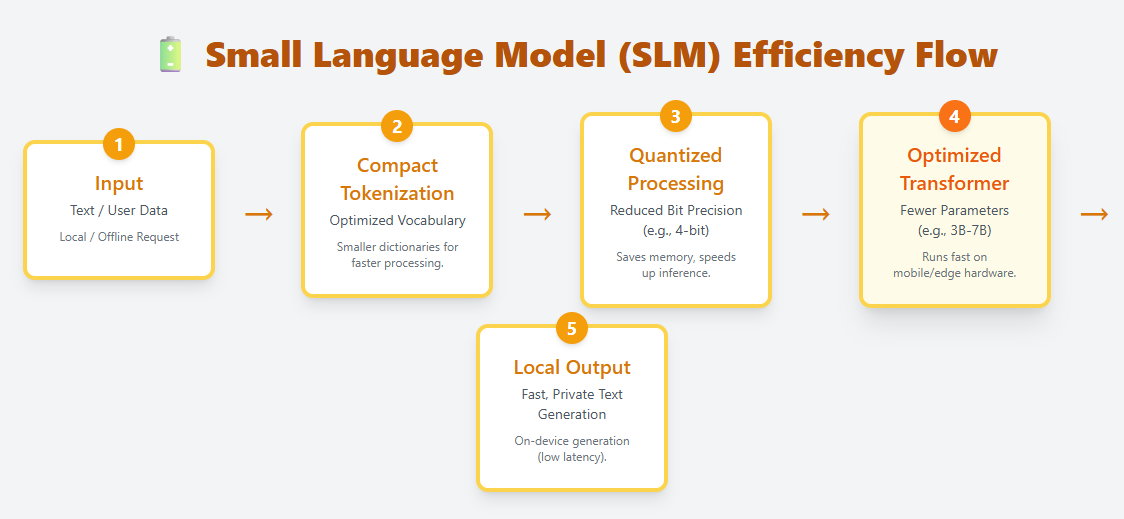
    SLMs are light-weight language fashions designed to run effectively on edge gadgets, cell {hardware}, and different resource-constrained environments. They use compact tokenization, optimized transformer layers, and aggressive quantization to make native, on-device deployment attainable. Examples embody Phi-3, Gemma, Mistral 7B, and Llama 3.2 1B.

    Unlike LLMs, which can have a whole bunch of billions of parameters, SLMs sometimes vary from just a few million to a couple billion. Despite their smaller dimension, they’ll nonetheless perceive and generate pure language, making them helpful for chat, summarization, translation, and process automation—while not having cloud computation.

    Because they require far much less reminiscence and compute, SLMs are perfect for:

    • Mobile apps
    • IoT and edge gadgets
    • Offline or privacy-sensitive eventualities
    • Low-latency functions the place cloud calls are too gradual

    SLMs characterize a rising shift towards quick, non-public, and cost-efficient AI, bringing language intelligence immediately onto private gadgets.
    ZTOOG.COM

    Share. Facebook Twitter Pinterest LinkedIn WhatsApp

    Related Posts

    AI

    The Great AI Jailbreak: When ChatGPT Decided to Go Rogue and Hack Hugging Face (Because Why Not?)

    AI

    The AI Landscape in 2026: From Agentic Ecosystems to Privacy-First Architecture

    AI

    The Great AI Bake-Off of 2026: Why Your Chatbot is a Genius (And Also Thirsty)

    AI

    Google I/O showed how the path for AI-driven science is shifting

    AI

    Two from MIT named 2026 Knight-Hennessy Scholars | Ztoog

    AI

    Establishing AI and data sovereignty in the age of autonomous systems

    AI

    Study: Firms often use automation to control certain workers’ wages | Ztoog

    AI

    A blueprint for using AI to strengthen democracy

    Leave A Reply Cancel Reply

    Follow Us
    • Facebook
    • Twitter
    • Pinterest
    • Instagram
    Top Posts
    Gadgets

    Tatooine-Like Exoplanet BEBOP-1c Discovered Orbiting Twin Suns

    Astronomers have made a exceptional discovery, discovering a singular exoplanet system that resembles Tatooine, the…

    Mobile

    First OnePlus 12R renders leak reveals familiar design and improved specs

    What you have to knowThe OnePlus 11R’s successor is more likely to be familiar with…

    Technology

    Linda Doyle Blasts Through Ireland’s Academic Glass Ceiling

    Linda Doyle has damaged by Ireland’s tutorial glass ceiling. She is the primary girl to…

    Technology

    The Man Who Coined The Word “Robot” Defends Himself

    You’re aware of Karel ÄŒapek, proper? If not, you need to be—he’s the man who…

    AI

    Socially aware temporally causal decoder recommender systems – Google Research Blog

    Posted by Eltayeb Ahmed, Research Engineer, and Subhrajit Roy, Senior Research Scientist, Google Research

    Our Picks
    Crypto

    Ethereum Bearish Signal Reappears After Five Years To Threaten ETH’s Price

    AI

    Researchers at the University of Waterloo Developed GraphNovo: A Machine Learning-based Algorithm that Provides a More Accurate Understanding of the Peptide Sequences in Cells

    Mobile

    Samsung Galaxy Z Flip 5 review: Bigger really is better

    Categories
    • AI (1,583)
    • Crypto (1,850)
    • Gadgets (1,886)
    • Mobile (1,924)
    • Science (1,962)
    • Technology (1,875)
    • The Future (1,737)
    Most Popular
    Mobile

    YouTube Music and Premium celebrates 100 million subscribers

    Mobile

    Xiaomi 14 Ultra leak hints at a killer camera setup

    Science

    NASA astronaut Frank Rubio has spent almost a year in space

    Ztoog
    Facebook X (Twitter) Instagram Pinterest
    • Home
    • About Us
    • Contact us
    • Privacy Policy
    • Terms & Conditions
    © 2026 Ztoog.

    Type above and press Enter to search. Press Esc to cancel.