
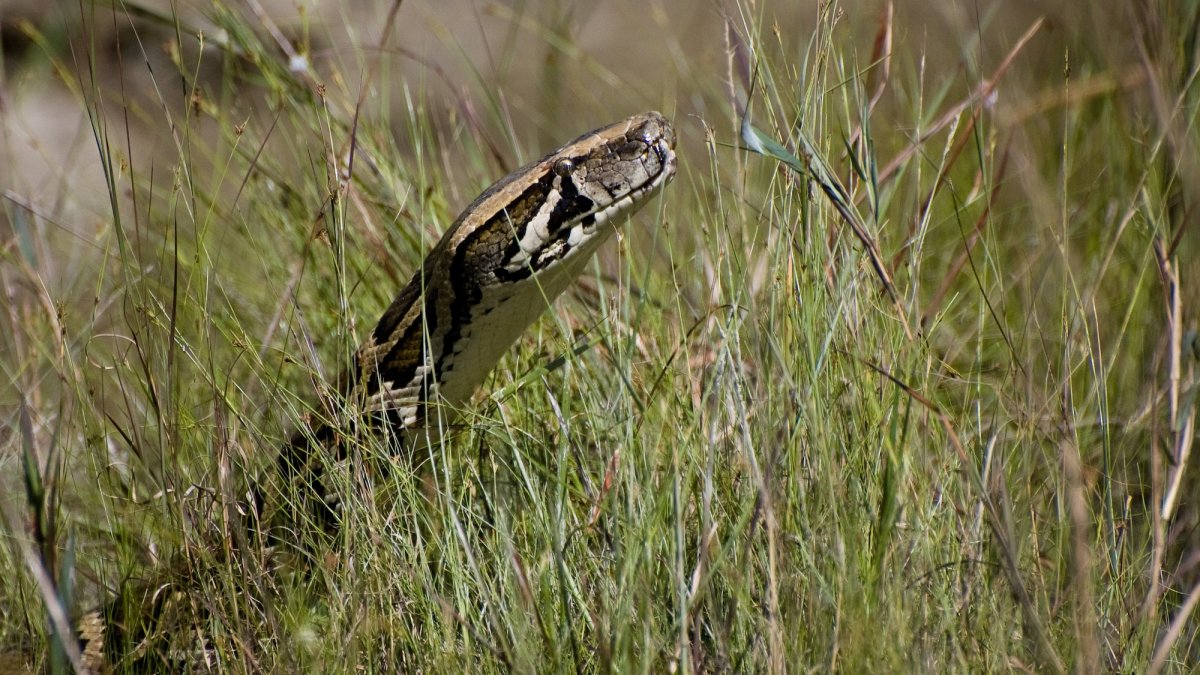
Florida’s fight against the Burmese python (Python bivittatus) is still going strong, and you can help tackle one of the state’s most troublesome invasive species. Recently, Everglades National Park announced it is once again teaming up with local groups for this year’s Florida Python Challenge.
The mission is simple: From July 10–19, participants are encouraged to safely capture and humanely kill as many pythons as possible. The snakes must then be brought to one of the competition’s designated checkpoints within 24 hours, where their lengths are recorded and added to the hunter’s total count. At the end of the ten days, prizes go to participants who catch the most snakes and those who nab the longest specimens.
“Protecting Everglades National Park, one of the globe’s most important ecosystems, needs ongoing collaborations and community involvement,” said Everglades National Park superintendent Pedro Ramos. “By involving the public in science-driven invasive species management, we can boost awareness and support for conservation throughout South Florida.”
Burmese pythons come from Southeast Asia but reached the U.S. during the 197s through the pet trade. Many unprepared Floridian owners released their oversized pythons into the wild when they realized these snakes could easily grow to a daunting 13 feet. The first few generations quickly adapted to Florida’s subtropical environment, faced no threat from local predators, and rose to dominance in the food chain.
The population of Burmese pythons in Florida has soared since then, devastating native wildlife and ecosystems. Though it’s hard to pinpoint their exact numbers, researchers have previously estimated anywhere from 100,000 to 300,000 pythons now living in the Everglades and surrounding regions.
Various ongoing efforts and experimental strategies are being tested, but one of the simplest ways to reduce the python population is to actively capture them. The first Florida Python Challenge took place in 2013, followed by an event in 2016, and it has become an annual tradition since 202. Last year, 934 participants from across the U.S. and Canada joined in, capturing a record 294 pythons in South Florida. The first-place winner, who collected 60 snakes in 10 days, walked away with a $10,000 prize. The longest snake caught was by someone in the “Novice” category, though snagging a 15-foot-11-inch python hardly seems novice to most people.
The Florida Python Challenge isn’t a free-for-all. Strict rules are in place, and any would-be snake hunters must complete an online safety course before heading into designated hunting zones. Firearms and trained hunting animals are not allowed. Instead, organizers suggest using air guns or methods like quickly impaling the snake through the head.
If you think you’ve got what it takes to tackle a major problem in a vital ecosystem, now’s the time to start sharpening your skills.